Reach Out and Connect

I spent Thanksgiving weekend with LucyKate in New York City. We took the Metro to Noho, walked through Soho, the Bowery, and Washington Square. After a ramen lunch in St. Mark’s, we heard people shouting our names, and finally turned around to find the Kerman girls & friends, running to catch us. AMAZING to connect with people from home in the US’ busiest city. But it’s the second time it’s happened to me. Last time I was here, I ran into Duane Halbur outside Grand Central Terminal!

November and the holidays are all about reaching out and connecting. This time of year does bring up some stuff, as do sickness and loss. A couple old friends and I broke china, shouted, and got past family resentments so they can connect with their father, who has cancer, and needs to tell his story, forgive, and ask for forgiveness over the next couple years. They want to mend their family connections, and are working hard to do it.

When I reported on Healthy Polk 2020, Priority #8, to the Polk County Board of Health, I emphasized connecting and reaching out. Few people on my expert team were connected before. They weren’t the “usual suspects” who guide community action in central Iowa. I interviewed each of them before we met, and used each unique perspective throughout the process. At the first meeting I put toys out, used computer key intros, played “Get on the Bus.” They shared their bios to ensure connection beyond the task at hand.

At the Iowa Non-Profit Summit, I facilitated a panel of Gerry Schnepf, Elvin McDonald, and Jan Herke. When Elvin began as Director of the Friends of the Botanical Center, the Board complained of littering and vandalism on the grounds. Elvin reached out to the school up the hill, and now the Boys & Girls Club brings kids down every week to garden 20 ten-by-ten-foot raised beds. They pick up litter on their way, and vandalism has not been a problem since.

Jan talked about Youth in Parks, a program that’s been going strong since I worked with Urbandale, West Des Moines and Ankeny on a partnership that continues to plan, train and evaluate the program together. They connect hundreds of middle school kids with service opportunities in parks, nursing homes, and day cares.

Gerry talked about how service learning connects kids to communities, so much that some research indicates they’re more likely to stay put when they’re grown. Keep Iowa Beautiful is developing Teachers Going Green, based on service learning and place-based education. Both of these approaches connect kids and schools with the communities around them.

LucyKate is studying Independent School Leadership at Teachers College, Columbia University. Over the holiday, we talked about education and relationships a lot. We watched this wonderful TEDx video with Brene Brown. Could vulnerability really be the key to connections? What do you think?
 

Don’t Forget to Travel

When I retired, my brother gave me luggage and said, “Don’t forget to travel.” Going on the road keeps my juices flowing. Last Thursday Tim and I took a little road trip to Mason City to explore some local architectural history.

The city recently opened the Historic Park Inn, designed by Frank Lloyd Wright and meticulously restored to the tune of about $20M. It is amazing! Besides the hotel, Frank Lloyd Wright’s Stockman House is a great example of the Prairie School of architecture. On Friday we walked through a neighborhood just east of downtown of well-preserved homes from the late 19th and early 20th centuries. The area includes Prairie, Craftsman, and Victorian styles. There are brass plaques embedded in the sidewalks with the name of the architect, the year the home was built, and the style of architecture.

We were pleasantly impressed by the vibe of Mason City. We ate three excellent meals at three very fine local restaurants. I didn’t expect that the local food movement had reached a town in northern Iowa. But Ralph’s is all about it. They are able to get nearly all their meat and eggs within 30 miles, and buy as much other food locally as possible.

Mason City’s other claim to fame is the boyhood home of “The Music Man.” Meredith Willson grew up there, and Tim and I both worked backstage on our high school productions of his famous play. We walked the footbridge over Willow Creek, but Tim drew the line at the tour of “Music Man Square.” Next time.

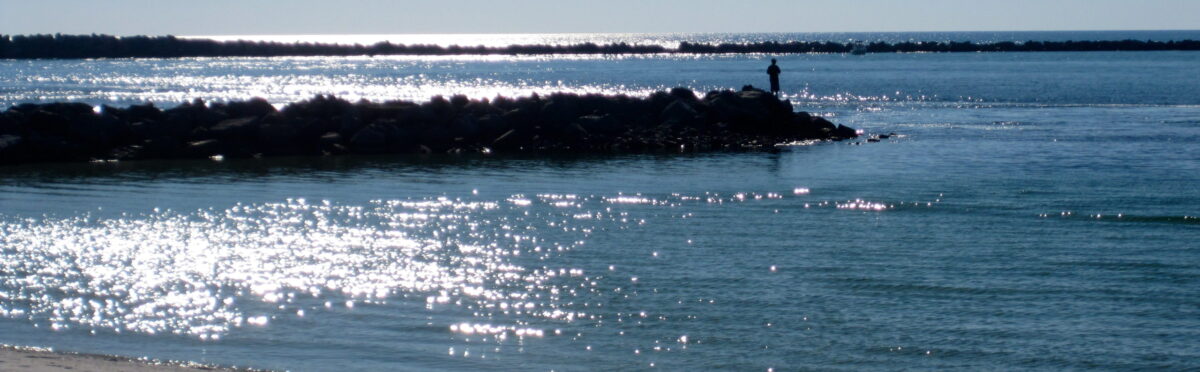
When we visited Florida last month, I painted two landscapes on the beach. I put my apron over my swimsuit, set up my plein air easel, and voila. Because the scene changes so quickly–people and umbrellas move, the light changes–there’s no pressure to take the time to get it down perfectly. I feel I captured the stormy feeling of the sky, and the carefree attitude of the coast.

A couple years ago, I made a trip to Greece and Turkey I had dreamed about since I was about twelve, and read “The Moonspinners.” My daughter and I explored Delphi, the Acropolis, and Meteora, archeological sites that inspired my childhood interest in Greek myths.

Though famously struggling these days, Greece has preserved its culture, identity, religion and homeland through Turkish, Persian, Roman, German and American occupations.  After several weeks in Greece, I concluded the secret of their survival is complete confidence that the culture that began there will prevail through time.

What’s the point? That getting out of the daily routine gives us new eyes. It opens possibilities we don’t see in day-to-day life. If I’m struggling with a project, even taking time out for a walk can loosen my mind enough to find the answer.

Get Healthy

Driving to Florida for vacation, we listened to three books–Connected, Thrive, and Switch. I learned about all of them when I worked with Healthy Polk 2020 last summer. My task was to gather a group of experts around the priority, “Empower more people to take more responsibility for maintaining their health.”

My team thought the wording of the priority judgmental. They took out “responsibility” and raised the bar from “maintaining” to enhancing. Their proposed priority reads, “Empower more people to enhance their health.” By building on strengths, people can leave stymied life roles behind, and move forward through trust-based relationships.

Of the ten Healthy Polk 2020 goals identified in 2009, this is the broadest, and the only one that addresses lifestyle and behavior. That’s where Switch comes in. It’s by Chip and Dan Heath, authors of Made to Stick, a book I’ve loved, shared, and used as reference for several years. Switch frames research about how change happens around a metaphor of elephant and rider.

All that Priority #8 of Healthy Polk 2020 seeks to change is, well, just the way we take care of our health, not just our physical health. My expert team defined health in broad terms, not just metabolic risk factors or healthy weight, but in terms of mental, spiritual, cultural and financial health. That’s where Thrive comes in.

Dan Buettner has conducted research all over the world, traveling to communities where people live the longest, happiest lives. One result is Thrive. Another is the Blue Zones Web site where it’s easy to spend a chunk of time, learning about yourself, and the things you can do to be healthier and happier. The Expert Team aligned their definition of health with the research of the Blue Zones project, addressing community, flow, meaningful work and other life style choices.

One of the cool things that happened with my Healthy Polk work is that about the same time we were wrapping up our work, Governor Branstad launched the Healthiest State initiative, and Wellmark announced funding for the Iowa BlueZones Project, through which ten Iowa communities will be able to develop tools and programs to live longer, happier lives.

Another gap my team identified was that neighborhoods and communities are not empowered to support and promote health. The action needed to close this gap needs further definition, but the vision is for churches, schools and neighborhood associations to develop networks that support healthy habits. Which is where the third book comes in. Connected explores the profound effect that our friends have on us. The research that caught my eye first is that people who hang out with obese people tend to gain weight. It makes sense, but surprised me nonetheless.

As my team discussed what “more people” meant, they envisioned a ripple effect, beginning with us, and spreading through our community organizations and friends. What do YOU think we need to do to start that ripple? Do you want to be a part of it? Let’s do it!