Row Your Boat

I got my water bill today. For a little over $70 a month, I get clean, safe water delivered to my sink, shower, tub, yard and toilet. I also get my garbage picked up, recycled, composted and dumped, and my sewage disposed of safely. How much do I even think of water? Not so much. But I am in a small minority of the world’s population that doesn’t worry about water.
In 2005, I visited Zambia, a butterfly-shaped country hugged by Botswana, Zimbabwe, Angola, South Africa…We started in Lusaka, the capitol, where my niece and daughter lived in a modern flat. We did laundry in the bathtub and hung it to dry on a clothesline strung across the bedroom, but we had running water. Oh, we boiled or filtered the water before we drank it. Or was that boil AND filter? But we had a flush toilet. We used the old motto–If it’s yellow let it mellow; if it’s brown flush it down. Still, we counted ourselves among the privileged.
We never quite erased the term “bathroom” from our vocabulary, even out in the bush where the “toilet” was a walk behind a bush or even a tall clump of grass! The term bathroom or restroom evokes a blank stare from most Zambians. I saw some ingenious solutions for these bodily functions, and learned to feel fairly comfortably without the comforts of home.
At Kabwata Cultural Centre, I visited a very unique toilet; when I asked one of the women where it was, she escorted me to a round, concrete structure behind the restaurant. It was concrete inside as well, with sink, shower stall and toilet molded of concrete.
The other unusual toilet we saw was built inside a giant Baobab tree at the Kayila Lodge where we stayed on the last night of our canoe safari. If you’ve been peeing behind a bush for 4 days, it borders on decadent. Electric lights, running water, a mirror (to be avoided at all costs!) and a little nicknack shelf with feathers and quills in a pot of sand. Who could ask for anything more?
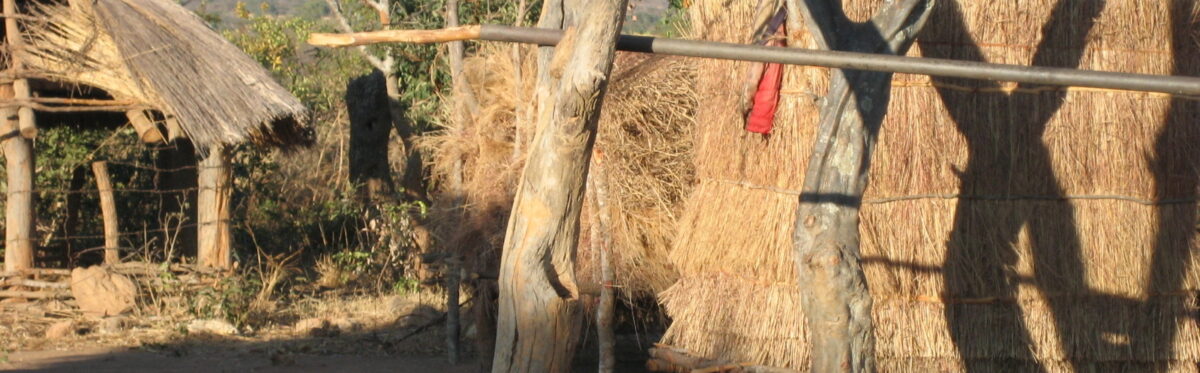
We visit Monze village, and turn back the clock at least 100 years. This is how most of the world deals with water. Toilet facilities are holes in the ground. When the toilet is full, the family fills it in and digs another nearby. Privacy appears to be valued above other amenities. Outhouses are built in the shape of a backward G so that when you squat, no one can see in from the outside. Usually there is a slit or a keyhole shaped hole in the floor.
The shower enclosure was ingenious, with a platform made of branches about 1 inch thick, suspended about a foot above the ground. This requires careful balance and planning so your feet don’t go through the space between the branches where the water drains onto the ground. Mr. and Mrs. Victor’s expansive hospitality included a shower to which they fetched water from about 2 kilometers away (about 2.5 miles round trip), and heated over an open fire.
The trip to Zambia was my first experience with the way most of the world gets their water–they carry it. Each day, women across the world spend more than 200 million hours collecting water for cooking and washing. It’s so easy to take for granted the things we receive with so little effort, and often difficult to improve the standards by which the developing world lives. But one young woman is doing something, and she’s been recognized for it. Glamour Magazine named her one of their 2010 Women of the Year. She is the youngest person ever to cross the Atlantic Ocean, solo for 70 days in a row boat.
When Katie Spotz was only 22 years old, she set out from Dakar, Senegal to raise money to provide safe drinking water projects for people around the world. She has extreme courage and single mindedness, and explains that the solo row was just something she had to do. She didn’t think about the danger. She is just passionate about completing the journey. Since her row, Katie has turned to biking; I am inspired by following her progress, and I hope you will be too.